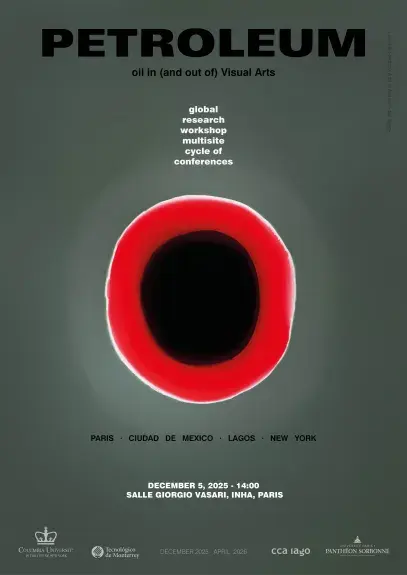
Oil in Contemporary Art - International Multi-Site Conference Series
International workshop, 5 december 2025, 14h Salle Vasari, INHA
Scientific managers: Lotte Arndt, Claire Betelu, Sarah Gould et David Castañer, HiCSA, Joaquín Barriendos, Tecnologico de Monterrey, Oyindamola Fakeye, CCA Lagos et Jennifer Wenzel, Columbia UniversityThe recognition that massive fossil fuel consumption is unsustainable for the planet was articulated in the 1972 Meadows Report and reaffirmed in the conclusions of the 1992 Rio Summit. Since then, the scientific literature has firmly established the link between hydrocarbon combustion, greenhouse gas emissions and global warming. In order to prevent a rise of temperature up to +4°C by the end of the 21st century, the international community adopted protocols in the 2010s to reduce carbon emissions into the atmosphere, notably through an energy transition. But ten years after the Paris Agreement (COP 21 in 2015), it has become clear that the transition is taking too long to implement. Faced with opposition from the private sector and inaction from state institutions, activists have employed various strategies to draw public attention, the most striking of which being the spilling of soup, paint and flour on masterpieces of modern and contemporary art. In 2022, Just Stop Oil, a group based in the UK, attacked works by Constable, Van Gogh and Vermeer. This modus operandi is the same in many other countries and has been adopted by several other associations in a network called the A22 Network, which aims above all to give visibility to environmentalist demands. Their idea is to change the plush peacefulness of museums— places that store the collective imagination of the past—in order to voice he ecological challenges of the present and the future.
But this gesture is also related to art worlds (Becker, 1982) and their entanglements with the oil industry. From the founding of MoMA in 1929 by the Rockefeller family—owners of the Standard Oil Company—to the emergence, in the 2010s, of new contemporary art hubs in the oil-producing countries of the Gulf, the history of the modern and contemporary art market is intimately linked to that of oil production, to the “umbilical cord” of oil, to paraphrase Greenberg. These links have already been challenged by art activist groups such as Free the Tate, Libérons le Louvre! and Art not Oil, whose aim has been to denounce the partnerships between oil giants and art world institutions and to ensure that the latter make clear ecological commitments.
How is the imperative of energy transition changing the art world? How are artists, curators, critics, conservators and restorers working towards a world without oil? To answer these questions, we intend to bring together artists, activists, curators, researchers and other art world actors in four cities in Atlantic countries with strong links to the history of oil: Lagos, Mexico City, New York and Paris. Over the course of four half-days, we propose to discuss across fields of activities and continents recent developments in contemporary art practices linked to ecological objectives, as well as the transformation of imaginary images of oil in the visual arts.


